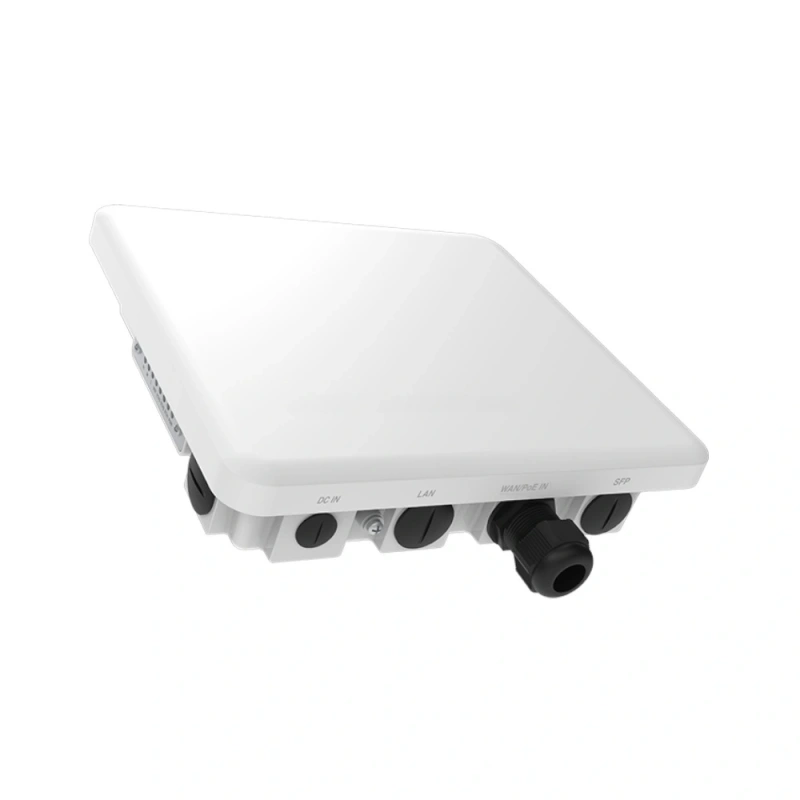
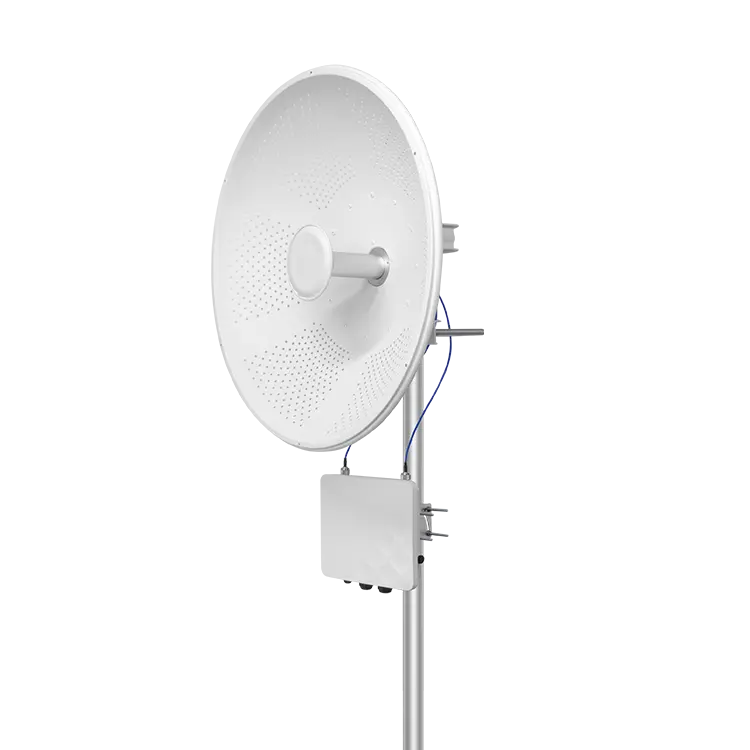
A buyer sends us a competitor’s spec sheet and asks a fair question: “This one says 40km at 1Gbps. Your 33dBi dish model only claims 20km+. Why is yours worse?”
It is not worse. It is honestly rated — and that difference is the subject of this article. Every extra kilometer of a point-to-point link has a price, paid in tower height, antenna size, legal transmit power, and throughput. Marketing pages skip the price column. Below is the full bill, from 1km backyard links to 40km tower-to-tower shots.
What actually limits how far a wireless bridge can reach?
Four things — and none of them is the radio’s willingness to transmit. Distance limits come from regulation and physics, which is why two honest manufacturers end up quoting similar numbers for similar hardware.
Legal power caps. Unlicensed 5GHz and 6GHz bands have regulated EIRP ceilings (transmit power plus antenna gain). Some regulators give fixed point-to-point links extra headroom on 5.8GHz, which is why the same hardware carries different ratings by market — but nobody gets unlimited power. Past the cap, the only lawful way to improve a link is a bigger receiving antenna and a cleaner path, not “more watts.”
Earth curvature. On long paths the planet itself gets in the way. At 10km the curvature bulge at mid-path is already about 1.5m; at 40km it grows to roughly 24m. That obstacle exists on every 40km link, no matter whose logo is on the radio.
Fresnel zone clearance. The signal does not travel as a thin ray but as a widening ellipsoid. At least 60% of that first Fresnel zone must be clear of trees, rooflines, and terrain, or throughput drops even with “visual” line of sight. Our wireless bridge installation checklist covers how to verify this before anyone climbs a ladder.
Noise floor. Every neighboring 5GHz network raises the noise your receiver must shout over, effectively shortening the usable range. This is one reason band choice matters for import buyers, and why clean 6GHz spectrum is attractive for demanding links.
How much antenna height do you need for a long link?
More than most people expect — this is the cost that marketing distance claims never mention. Over flat terrain, your antennas must clear the earth-curvature bulge plus 60% of the Fresnel zone. First-order estimates at 5.8GHz:
| Path length | Curvature bulge at midpoint | 60% Fresnel radius | Minimum mounting height, both ends |
|---|---|---|---|
| 1km | negligible | ~2.2m | ~3m — a rooftop or eave is enough |
| 5km | ~0.4m | ~4.8m | ~6m — gable mast or small pole |
| 10km | ~1.5m | ~6.8m | ~9m — dedicated pole or rooftop tower |
| 20km | ~5.9m | ~9.7m | ~16m — engineered mast or lattice tower |
| 40km | ~23.5m | ~13.6m | ~37m — professional towers at both ends |
These are flat-terrain estimates with nothing else in the path; hilltop sites can subtract terrain height, and any tree line adds to it. Always run a path profile for the actual coordinates before ordering hardware — send us the two endpoints and we will run it with you.
The table explains most “40km bridge” disappointment in one line: at 40km the problem stops being electronics and becomes civil engineering. Two 37m towers, their foundations, and their permits cost far more than any pair of radios — which is exactly why that figure stays off the marketing page.
What can you realistically get at each distance?
Here is how the distance tiers break down in real deployments, with the hardware class each one genuinely requires:
| Distance | Realistic expectation | Hardware class | MossLink models |
|---|---|---|---|
| Under 1km | Near-rated throughput, minimal planning | Entry CPE, 12–14dBi panel | WB451H, WB501C |
| 1–5km | 300–500Mbps real TCP on 900Mbps-class radios | 14–16dBi panel or compact dish | WB610H, WB630, WB730 |
| 5–16km | High throughput near, tapering with distance; TDMA matters | Industrial Wi-Fi 6, 20dBi flat panel | WB5axH6-20 |
| 16–25km | Hundreds of Mbps with ≥-70dBm received signal | 33dBi parabolic dish | WB5axH6-35, WB6axH6-20 |
| Beyond 25km | ~30km with external high-gain antenna options; past that, change technology | Licensed microwave or fiber | see below |
A few notes on reading this table honestly:
Under 1km is the easy tier — the one where a $100-class bridge pair genuinely replaces a trenching quote. If that is your scenario, our garage, barn and shed guide covers it end to end.
1–5km is where most CCTV backhaul and Starlink-sharing projects live. The 900Mbps-class 802.11ac platforms hold several hundred Mbps of real TCP here, comfortably carrying 20+ camera channels or a full Starlink connection.
Above 16km, the -70dBm rule governs everything: keep the received signal stronger than -70dBm and modern Wi-Fi 6 dishes deliver hundreds of Mbps; let it slip weaker and the radio trades speed for stability, fast. Distance and throughput stop being independent numbers — you buy one with the other.
Beyond 25km, we would rather lose the order than pretend. The WB5axH6-35 supports external high-gain antennas for links up to about 30km, and past that point the honest engineering answer is licensed microwave or fiber. Our wireless vs fiber comparison walks through where that crossover sits for different budgets.
Why do “40km at 1Gbps” claims deserve questions?
Because on unlicensed 5GHz, that combination requires everything to go right at once — and real sites rarely cooperate. With EIRP capped by law, closing a 40km link budget at gigabit-capable modulation needs large dishes at both ends, towers tall enough to clear a 24m curvature bulge plus the Fresnel zone, and a noise floor quiet enough to hold high MCS rates. Each condition is individually achievable. All three together describe a remote, purpose-built tower site — not a typical customer deployment.
The systems that genuinely deliver 40km+ at gigabit speeds — Ubiquiti’s AirFiber 5XHD class and licensed microwave gear — do it with specialized spectrum access, large-aperture antennas, and professional tower infrastructure. That is legitimate engineering, and if your project truly needs it, that is the correct product category. What deserves questions is a $200 unlicensed bridge borrowing those numbers with none of those conditions attached.
Our own position is simple: our 33dBi dish models are rated 20km+ because that is what they deliver on realistic towers with proper clearance. When a project pushes past the rated envelope, we say so, run the path profile together, and validate with field-tested samples before anyone commits to volume — the same “trust the measurement, not the datasheet” principle behind our real-world PtMP throughput report.
Does the answer change for PtP vs PtMP?
Yes — everything above describes a single point-to-point link, which is the best case. In point-to-multipoint, one base station shares airtime across every client, so per-subscriber throughput falls as distance and client count rise, and the practical range envelope tightens. If you are planning a multi-client network rather than one dedicated link, read our real-world PtMP throughput and range breakdown — it covers sector planning, client density, and the same -70dBm discipline applied to WISP deployments.
Get a distance-honest recommendation
Tell us your two endpoints and the bandwidth you actually need, and we will tell you which tier you are in — including when the answer is “fiber” or “a taller mast,” because a returned container costs both of us more than an honest first answer. Browse the full wireless bridge lineup, message us on WhatsApp for a quick path check, or request a quote with your coordinates and we will run the link budget before you spend anything.
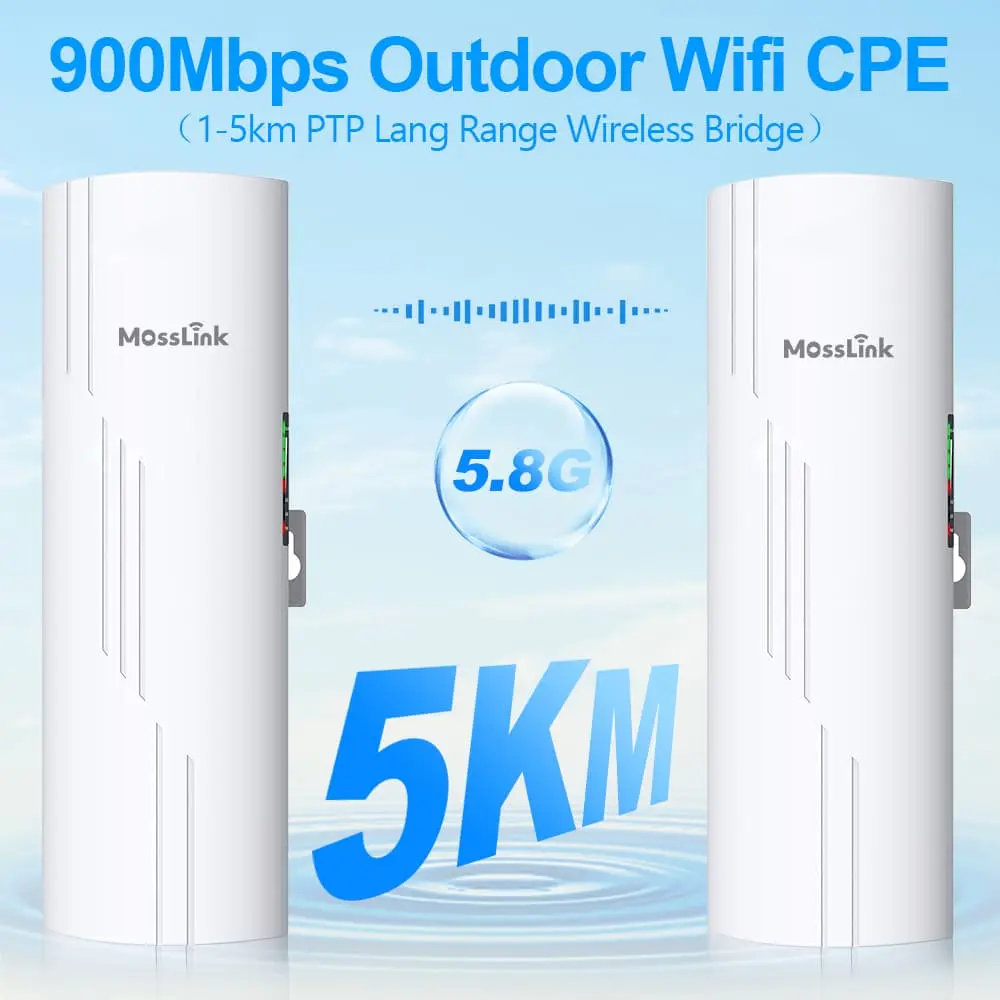
Featured in this guide
Frequently Asked Questions
Practical answers for planning a similar network.
How far can a wireless bridge work without line of sight?
Does rain affect long-range wireless bridges?
What speed can I realistically get at 20km?
Can I extend range with a relay hop?
Plan the complete link
Get a point-to-point wireless bridge kit recommendation
Tell us the distance, throughput, power source, and deployment environment. We will match the bridge pair, PoE, outdoor cable, and mounting accessories.
Continue Planning Your Wireless Link
Deploy with confidence
See how MossLink builds ISP CPE & Hotspot Deployment Solution end-to-end
Network architecture, products used, and real-world results in one place.
Tags
Share