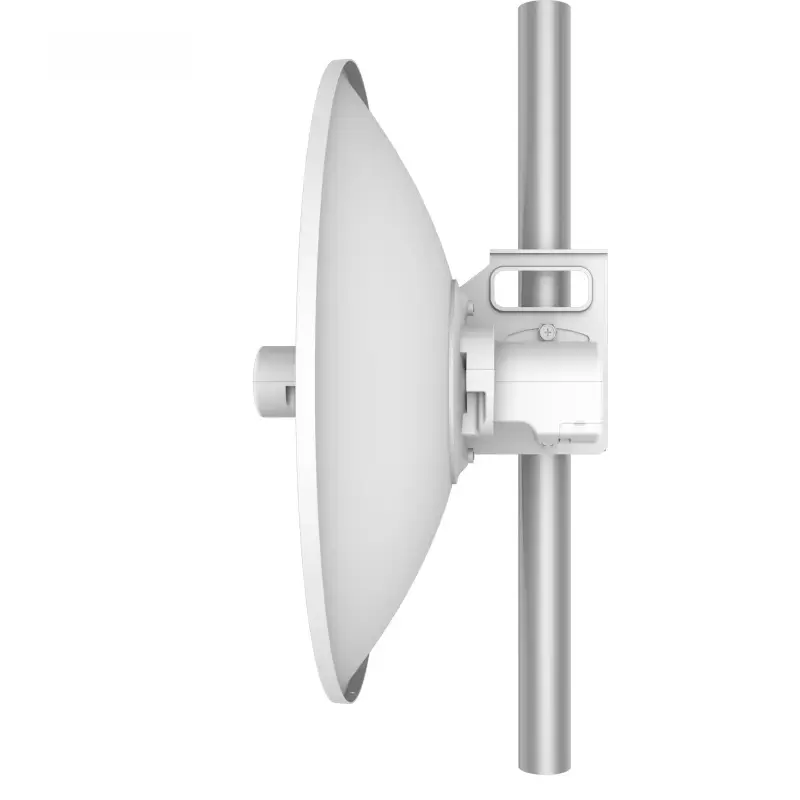
rural
Rural & Long-Range Wireless Backhaul Solution — MossLink Manufacturer
Multi-hop wireless backhaul network connecting remote rural communities to fiber PoPs across distances of 5–30 km, over mountainous or agricultural terrain with no existing cable infrastructure
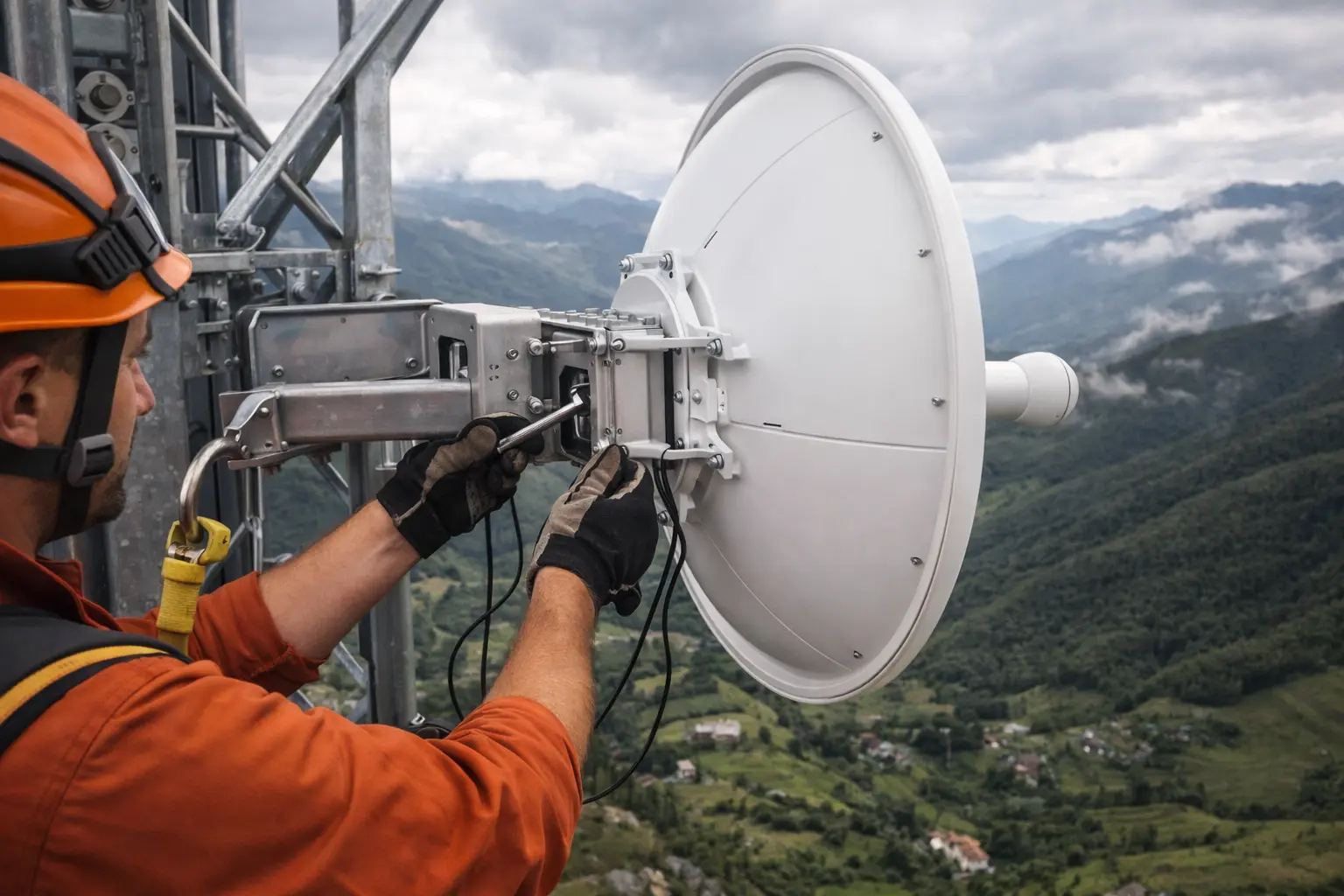
The Challenge
Rural communities in emerging markets sit beyond the economically viable boundary for fiber deployment. Terrain — mountains, rivers, forest — makes cable routes physically challenging, and low subscriber density makes the capital investment in trenching or aerial fiber impossible to justify. NGOs, government broadband programs, and rural ISPs need wireless infrastructure that covers tens of kilometers reliably, survives harsh outdoor conditions, and can be maintained by local staff without specialized RF engineering skills.
Network Architecture
Network Architecture
Our Approach
MossLink's rural backhaul solution uses high-gain dish antenna bridges for the long-haul backbone links, with subscriber-side CPE routers for the final connection into homes and businesses. Multi-hop relay chains extend coverage across terrain that no single link can span, while IP67 housings and wide operating temperature ranges ensure reliable operation without permanent local staff.
The Challenge
Billions of people in rural Africa, South and Southeast Asia, and parts of Latin America live beyond the practical reach of fiber internet. The math is simple: fiber costs $15,000–$50,000 per km to deploy, and a rural village of 200 households cannot generate enough subscription revenue to justify it. Mobile data exists in some areas, but bandwidth is insufficient and costs are prohibitive for sustained broadband use.
The solution is point-to-point wireless backhaul — but equipment must meet demanding criteria. Links must span 10–35 km across terrain with no existing infrastructure. Towers must operate reliably for years without on-site maintenance, in climates ranging from Sub-Saharan heat and humidity to Andean cold. Local communities often have no trained IT staff, so installation must be simple enough for community members or local agents to execute.
At the same time, rural broadband programs — whether funded by governments, development banks, or NGOs — operate under tight budgets. Equipment cost per subscriber connection is scrutinized closely, and procurement often requires international certification documentation.
Our Approach
MossLink’s rural backhaul solution is built around a relay chain architecture that adapts to any terrain:
Long-Haul Backbone: The WB5axH6-35 forms the backbone of each link segment. Its 29 dBi dish antenna and 5 GHz 802.11ac radio delivers 867 Mbps throughput at distances up to 35 km. At rural ISP scale, 20–50 Mbps is typically sufficient for a village of 50–200 concurrent users, meaning a single backbone link supports multiple communities simultaneously.
Extended Range Links: For sites requiring absolute maximum range — mountain passes, remote lake communities, island-to-island links — the 30 KM bridge series adds higher-gain antennas and optimized link budgets for maximum propagation distance.
Mid-Range Distribution: The WB2500 covers 1–15 km distribution segments, connecting relay nodes to sub-distribution points at village centers. Its 2.5 Gbps throughput capacity ensures the distribution layer never becomes a bottleneck as subscriber counts grow.
Subscriber-Side CPE: The YA796 outdoor CPE router mounts on a rooftop pole at each household or small business. Its LED signal strength indicator guides precise alignment during installation — no RF analyzer required. Setup takes 15 minutes, enabling community-led rollout without professional installers at every site.
Multi-Hop Architecture
Coverage across complex terrain follows a relay chain:
- Fiber PoP at nearest town — connects to national or regional internet backbone
- Primary backbone tower — WB5axH6-35 PtP link spans 15–30 km to hilltop relay
- Relay node at ridge line — receives backbone, rebroadcasts to secondary coverage area
- Distribution points — WB2500 units at village centers distribute connectivity locally
- Subscriber CPE — YA796 at each home, mounted on pole, connects to distribution point
Each relay node adds roughly 15–30 km of reach. Two hops can cover 50+ km from the fiber PoP. The relay hardware runs on 10–15 W, compatible with small solar systems at sites without grid power.
Results
Rural broadband programs using MossLink infrastructure report deployment cost reductions of 80% versus equivalent fiber routes, with backbone link stability sufficient for VoIP, video calling, and basic streaming from communities that previously had no internet access. IP67 hardware typically operates maintenance-free for 3–5 years in tropical climates.
MossLink supplies rural backhaul equipment factory-direct with CE/FCC documentation suitable for government and NGO procurement processes. OEM customization for regional branding programs is available. Contact us for project consultation and volume pricing.
Results
- Backbone links covering 20–35 km from a single tower using WB5axH6-35 with 29 dBi dish antenna
- Multi-hop relay architecture extends coverage across mountains and valleys where single links fail
- Subscriber CPE self-installation in under 15 minutes — local agents can deploy without training
- Deployment cost 80% lower than laying fiber across equivalent rural distances
- IP67 weatherproofing survives monsoon seasons, tropical humidity, and desert temperature swings
- Solar-compatible power consumption enables off-grid tower deployments in communities without grid power
- CE/FCC certification supports deployment in international NGO and government-funded programs
Products Used in This Solution

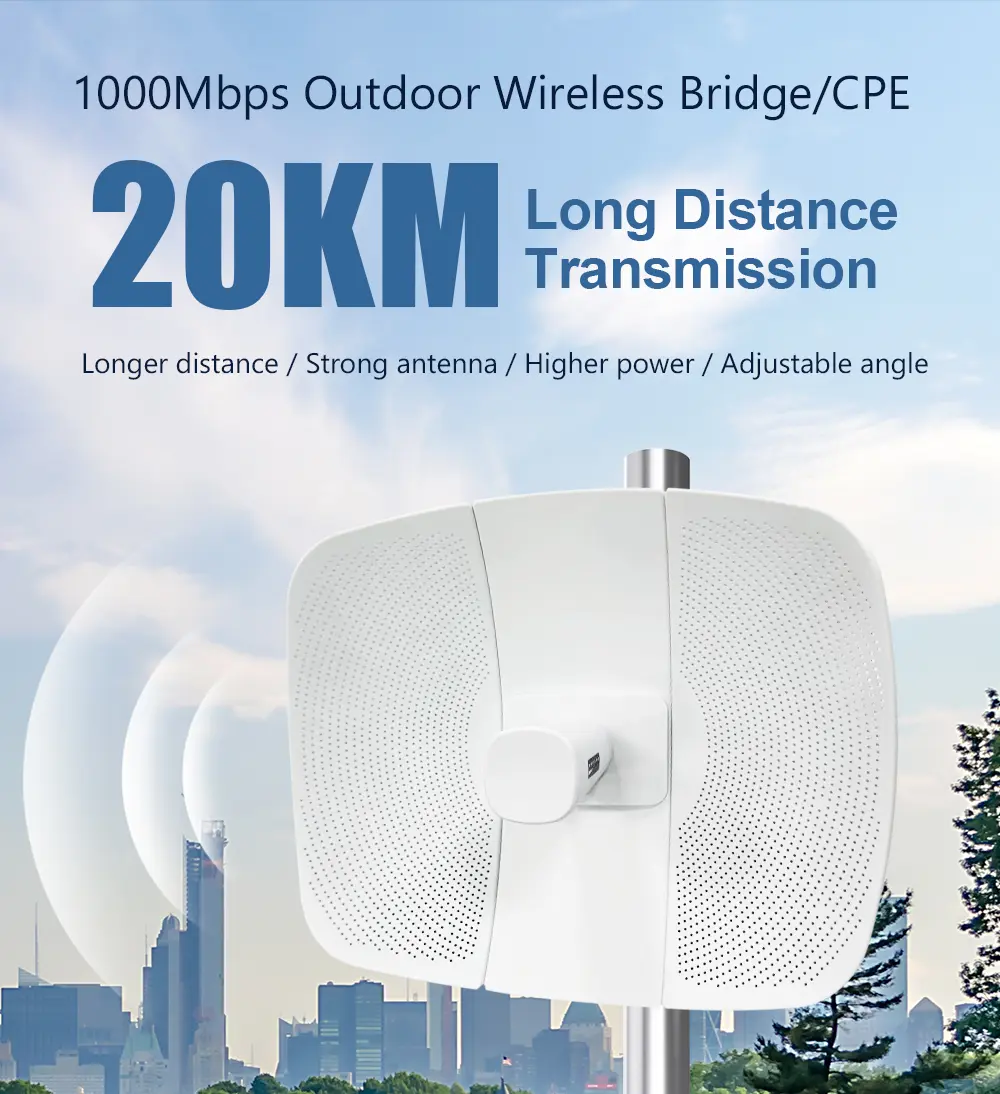
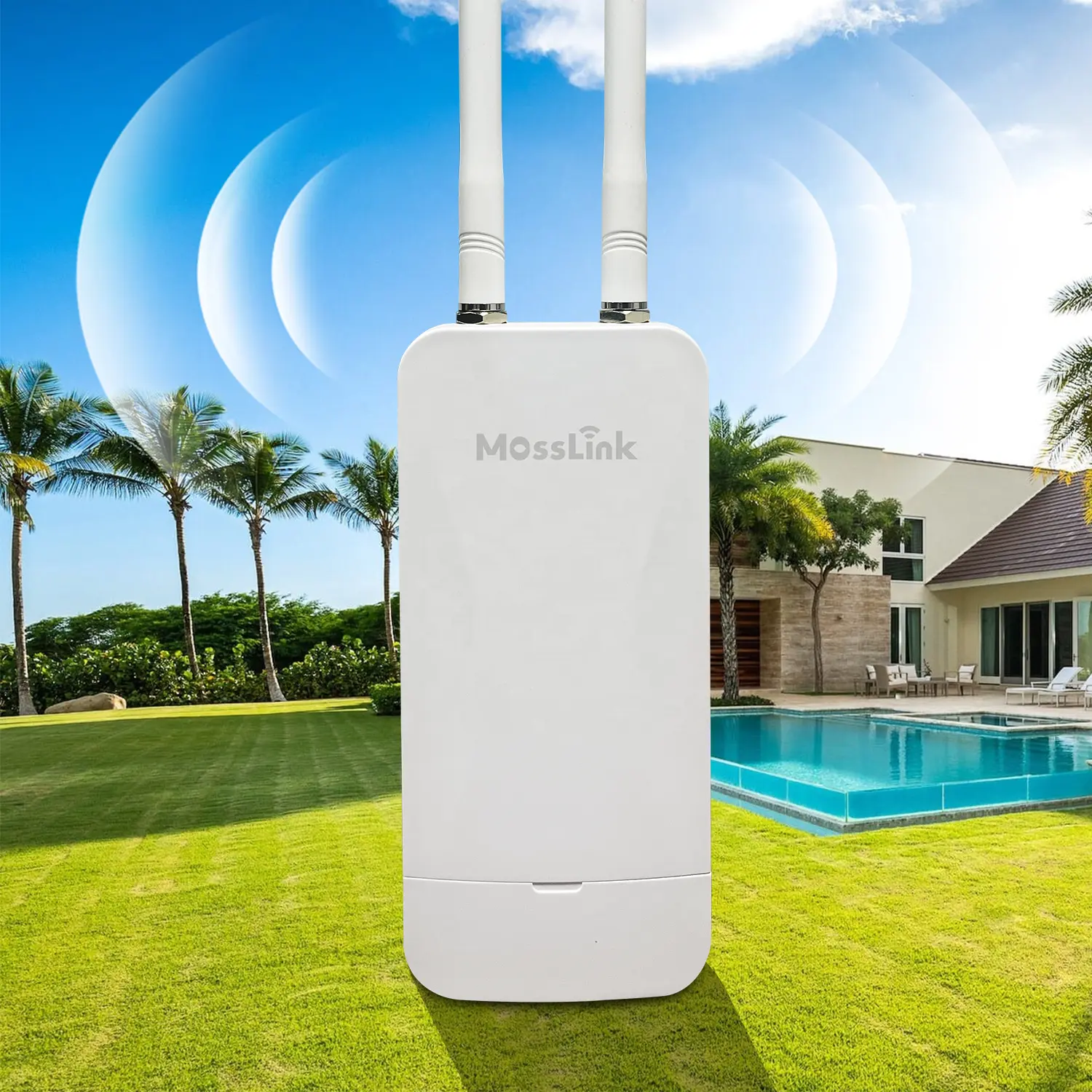
YA796 AC1200 MU-MIMO Outdoor Access Point, IP65, Gigabit Ports
YA796
Wi-Fi 5 (802.11ac) · Dual-Band (2.4GHz + 5GHz) · AC1200 (300 + 866 Mbps) · 24V PoE / 12V DC 1A
Interested in This Solution?
Let our team design a customized rural networking solution for your project. Get expert guidance and factory-direct pricing.