What are the specific customization options I can get for OpenWrt firmware, such as captive portal or custom authentication/billing integration?
OpenWrt Customization Guide: Firmware, Captive Portal, and Billing
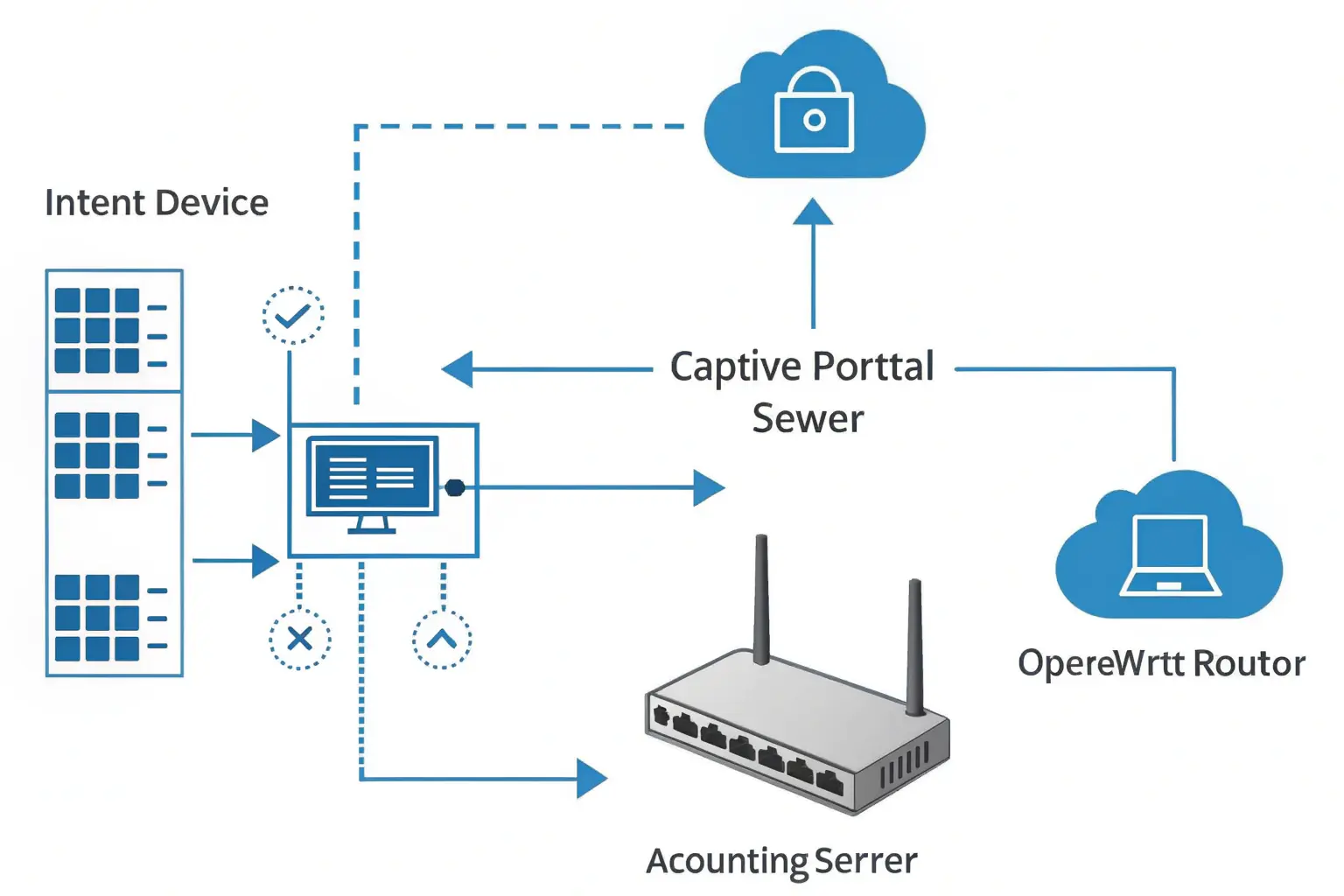
Achieving deep OpenWrt Customization is the key for System Integrators (SIs) and WISPs who need to transform standard routers into revenue-generating assets. Standard firmware is often a dead end, lacking the flexibility to monetize networks, enforce strict policies, or integrate with legacy billing systems.
This is where OpenWrt shines. We aren’t just talking about basic routing; we are talking about baking sophisticated **Captive Portals**, external **AAA (Authentication, Authorization, Accounting)**, and custom billing logic directly into the firmware image.
This guide explores specific OpenWrt customization options—from selecting the right portal software to deep kernel-level tuning—that allow you to match your project’s exact requirements.
1. Network Authentication: The “Front Door” of Your Service
Authentication is the critical first step for any public or enterprise network. You need a system that is robust enough to handle thousands of sessions but flexible enough to support vouchers, social logins, or paid access.
In the OpenWrt ecosystem, we move away from rigid, proprietary gateways. Instead, we use package-based solutions that can talk to any backend you choose.
| Portal Software | Key Features | Best Use Case |
|---|---|---|
| OpenNDS (Recommended) | Modern architecture, supports FAS (Forward Authentication Service), custom web stacks, and PreAuth hooks. | Paid Wi-Fi, Marketing Hotspots, Dynamic Splash Pages. |
| CoovaChilli | Industry-standard RADIUS NAS implementation. Highly compatible with legacy billing systems. | Large scale ISPs, Traditional WISP Hotspots. |
| uspot / Lua-based | Lightweight, scriptable logic. Runs locally without needing heavy external servers. | Voucher systems, Small Venues, Offline authentication. |
For most modern deployments, **OpenNDS** is the superior choice. Its ability to offload the splash page logic to a remote server (via FAS) means you can update your marketing campaigns or payment flows instantly without touching the router firmware.
2. Monetization and Traffic Control
Authentication identifies the user, but **Accounting** and **QoS** are what protect your revenue and network quality. Integrating a billing system involves configuring OpenWrt to act as a Network Access Server (NAS) that reports usage data to your RADIUS server.
However, enforcing limits isn’t enough. You must also manage the user experience. This is where **SQM (Smart Queue Management)** comes in. Unlike simple rate limiting, SQM uses algorithms (like CAKE or FQ_CODEL) to manage bufferbloat, ensuring that a single user downloading a large file doesn’t kill the latency for everyone else’s VoIP calls.
| Control Mechanism | OpenWrt Feature | Operational Purpose |
|---|---|---|
| User Quotas | RADIUS Accounting | Disconnects users when time/data limits are reached (Prepaid model). |
| Session Limits | Captive Portal Enforcer | Hard stops on bandwidth per session to prevent abuse. |
| Latency Control | SQM QoS (CAKE/FQ_CODEL) | Eliminates lag/bufferbloat during congestion. The “Killer App” for user experience. |
The SQM Advantage: Standard routers struggle when the uplink is saturated. OpenWrt with SQM optimization can make a mid-range hardware device outperform premium proprietary routers in real-world loading tests. This is a massive selling point for WISPs dealing with limited backhaul capacity.
3. Deep OpenWrt Customization: Beyond Packages
Installing packages is just the surface. For System Integrators deploying thousands of units, we use the **OpenWrt Build System** to create “Pre-Baked” firmware images.
This allows for extensive OpenWrt customization, ensuring every router flashes with your specific branding, default configurations, and security scripts already in place. It eliminates the need for manual setup and guarantees consistency across your fleet.
| Customization Layer | Tool / Method | Strategic Value |
|---|---|---|
| Firmware Image | Image Builder | Pre-bake configs and branding. Mass deployment ready. |
| App Integration | Lua / Python / uhttpd | Run custom billing agents or IoT collectors directly on the router edge. |
| Fleet Management | OpenWISP | Centralized controller for configuration, monitoring, and RADIUS integration. |
4. Engineering Insights: Why Choose Custom OpenWrt?
Before you request a custom build, understand the technical levers available to you. These are features often locked down in proprietary firmware that **OpenWrt customization** unlocks for professional use.
Global RF and Compliance Control
Stock firmware locks radio power and channels to specific regions. OpenWrt allows for the modification of country codes (where legally appropriate), unlocking the hardware’s physical potential. This allows for cleaner channel selection and optimized transmit power for specific environments.
SSID Virtualization (Multi-Tenant)
We can configure a single router to broadcast multiple SSIDs, each mapped to a separate VLAN with unique firewall rules. This turns a $100 consumer device into an enterprise-grade multi-tenant node, perfect for isolating IoT devices from Guest networks or serving multiple small businesses from one feed.
Speed vs. Stability Trade-offs
Marketing teams love 80MHz and 160MHz channel widths because they show big speed numbers. Engineers know these widths catch more interference. With custom OpenWrt, we can force 20MHz or 40MHz channel widths, actively trading “marketing speed” for “rock-solid stability.”
Decentralized Mesh (802.11s)
Unlike proprietary mesh systems that lock you into one brand, OpenWrt utilizes the 802.11s standard. This allows you to build self-healing, decentralized mesh networks using mixed hardware models, breaking vendor lock-in and lowering total cost of ownership.
Build Your Custom Network Solution
Whether you need a custom Captive Portal for a hotel chain or a specialized WISP firmware with billing integration, Mosslink has the engineering expertise to build it. Don’t settle for stock limitations.
Specialized engineering support for System Integrators and Hardware Vendors.
Share